
PA6 / PA66 sourcing essentials: moisture absorption, viscosity, melting point and reinforcement ratio
PA Selection · 2026year9month24day
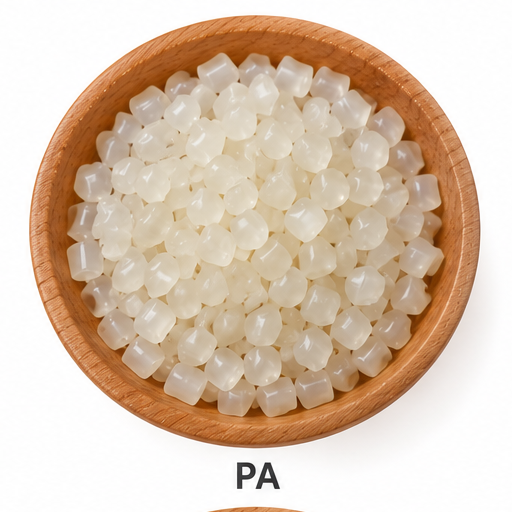
PA datasheets must be read together with moisture status. Dry-as-molded strength, conditioned strength and actual molding performance may differ. For glass-fiber-reinforced PA, fiber content, flow direction and warpage also affect the final result.
When sourcing PA, treat PA6/PA66 type, viscosity grade, moisture content, reinforcement ratio and drying requirements as equally important specifications.
Basic differences between PA6 and PA66
| Item | Typical PA6 direction | Typical PA66 direction |
|---|---|---|
| Melting Point | Approx. 220°C | Approx. 260°C |
| moisture absorption | Significant; drying and conditioning must be controlled | Also needs control; dimensions and strength depend more on conditioning state |
| Selection Focus | flow, toughness, cost and processing window | Heat-Resistant、rigidity、dimensional stability and long-term service temperature |
BASF Ultramid Product Information lists the PA6 B-series melting point as 220°C, with B33, B36, B40 and higher grades distinguished by relative viscosity; common PA66 A-series melting points are 260°C. These values are only for initial material-system screening and cannot replace the TDS for a specific grade.
moisture absorptionWhy moisture changes the result
For example, typical BASF Ultramid B3M6 PA6-M30 data show equilibrium moisture absorption at 23°C/50% RH of 2.2–2.6%, while moisture absorption at saturation in water is approximately 5.9–6.5%. Moisture content affects toughness, dimensions, appearance and processing stability; tensile data for the same grade in dry and conditioned states must not be compared directly.
More glass fiber is not always better
- Unreinforced PA: Flow and toughness are usually easier to balance, making this suitable for general structural parts, gears, clips and similar components.
- PA6-GF30: Rigidity, heat-distortion resistance and dimensional retention improve, but warpage, weld lines and fiber orientation must be validated carefully.
- Higher reinforcement ratios: Suitable for high-rigidity, load-bearing structural parts, but with a narrower processing window, greater mold wear and higher appearance-control requirements.
PA sourcing and inspection checklist
Specify PA6 or PA66, glass-fiber content, flame-retardant/heat-resistant/hydrolysis-resistant requirements, viscosity or MVR, drying conditions, packaging moisture content and target application in the inquiry. During trials, record melt temperature, mold temperature, post-drying dew point, conditioning time after molding and dimensional changes. For load-bearing parts, validate strength, impact and dimensions in both dry and conditioned states.
Reference Documentation
Basic parameters reference BASF Ultramid PA6/PA66 official product information and datasheets: BASF Ultramid product range、BASF Ultramid B3M6 datasheet. Actual data is subject to the latest TDS for the target grade, color and conditioning state.
Need PA6 / PA66 selection support?
Send us the service temperature, load, moisture environment and reinforcement requirements; we will compare suitable nylon grades for you.