AS (SAN) transparent-part sourcing: balancing flow and heat resistance
AS / SAN Selection · 2026year10month10day
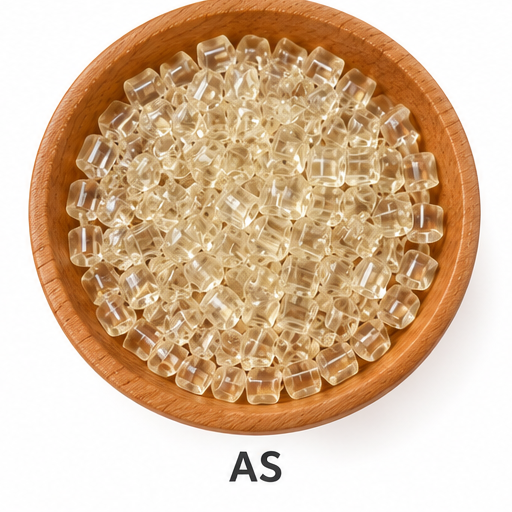
AS, also written as SAN, is a transparent, rigid resin made from styrene and acrylonitrile. Sourcing usually requires a balance among transparency, flow, chemical resistance and heat resistance.
For transparent cups, appliance windows and thin-wall containers, higher MVR is not always better. Also evaluate stress cracking, yellowing, residual stress and dimensional stability.
Three parameter groups for initial screening
| parameters | How to interpret the reference | Applications to consider |
|---|---|---|
| MVR | High MVR makes mold filling easier, but strength and stress must be validated | Thin-wall parts, complex runners and transparent appearance parts |
| Tensile Modulus | Useful for comparing rigidity, but not a substitute for product testing | Transparent housings, brackets and structural parts |
| Vicat | Useful for comparing heat-softening trends; confirm the test method | Hot-water parts, lighting parts and parts near heat sources |
How to read typical INEOS Luran data
In the INEOS official product table, the MVR (220°C/10 kg) of SAN grade Luran 338L is 40 cm³/10 min、Tensile Modulus 3500 MPa、Vicat 105°C, positioning it for easy-flow thin-wall molding. The MVR of Luran 368R is 10、Tensile Modulus 3700 MPa、Vicat 106°C, with a stronger general-purpose balance.
These data suggest that when the runner is short and the wall is relatively thick, the highest-flow grade is not automatically necessary. When the part is thin-wall and appearance requirements are high, prioritize higher-MVR grades and validate weld lines and residual stress.
How to initially distinguish AS, ABS and PC
- When transparency and rigidity are required: Prioritize AS/SAN, while noting that its impact capability is generally not equivalent to ABS.
- When impact resistance and housing toughness are required: Start with ABS; it is more suitable when transparency is not the primary requirement.
- When high impact resistance and heat resistance are required: Consider PC, while allowing for higher material cost, stricter drying requirements and higher processing temperatures.
Validation steps not to omit when sourcing transparent parts
In addition to MVR and Vicat, confirm haze/light transmittance, yellowing, chemical-resistance media, molding shrinkage, drying conditions and food or medical compliance. For transparent parts, run a small trial first and use the actual wall thickness and cooling conditions to evaluate flow marks, silver streaks, stress marks and assembly dimensions.
Reference Documentation
Parameters reference Luran SAN grade data in the INEOS Styrolution official product catalog: INEOS official product catalog. Actual data is subject to the latest TDS for the target grade.
How do we match a transparent AS grade?
Provide the wall thickness, molding process and transparency requirements; we will screen grades for the right balance of flow and heat resistance.